Violet’s Conversation with Her Parents About Eleanor and Finch
All the Bright PlacesViolet’s Conversation with Her Parents About Eleanor and Finch brings Violet Markey’s grief out of private rumination and into the family room. She tells James Markey and Sheryl Markey that she misses Eleanor Markey, confesses the guilt she has carried about the fatal drive, and speaks plainly about loving Theodore Finch. The conversation does not undo either death. Instead, it changes what the family can say to one another: remembrance becomes a shared act rather than a silence Violet has to maintain alone.
Beginning by refusing silence
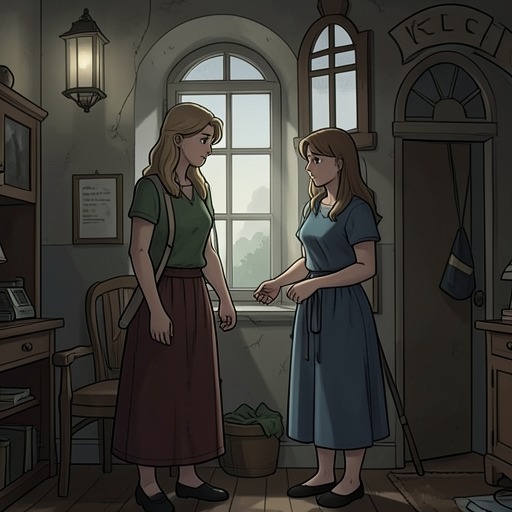
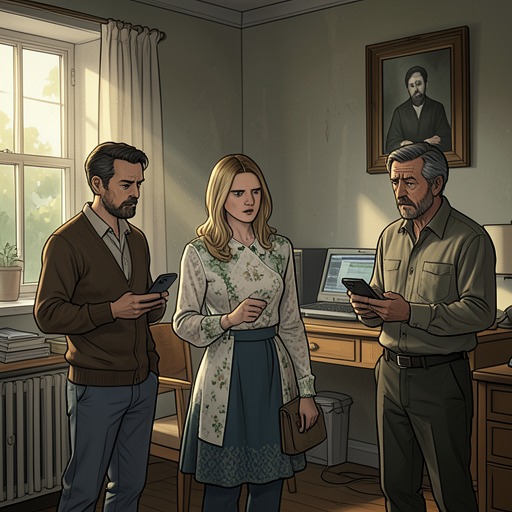
Violet finds her parents together in the family room: James is listening to music through headphones, while Sheryl is grading papers. Violet asks them to talk about Eleanor and not to forget that she existed. Her father removes his headphones, a small but visible response to the request. The ordinary details of the room make the scene’s emotional stakes concrete: Violet is interrupting the household’s routine because she no longer wants grief treated as something that can be set aside.
As her parents try to interrupt, Violet speaks louder. Her insistence is not an attempt to argue away what happened; she says they cannot go backward, change the past, or bring Eleanor or Theodore Finch back. What she refuses is the further loss that silence threatens. She says that tiptoeing around Eleanor, Theodore, and her parents makes it harder to remember the people she has lost. The conversation therefore turns on a distinction between accepting that the past cannot be changed and pretending that it no longer needs to be spoken about.
Eleanor Markey, guilt, and memory
Violet tells her parents that she misses Eleanor and cannot believe she is alive while her sister is not. She apologizes for going out that night and for suggesting that Eleanor take the bridge home. In Violet’s account, the suggestion is tied to the route Eleanor took before the accident; Violet’s apology exposes the self-blame beneath her grief. She does not claim that the conversation can settle that guilt. She gives it a voice instead of allowing it to remain hidden behind the family’s attempts to avoid painful subjects.
Her effort to remember Eleanor is intimate and specific. Violet concentrates on her sister’s voice: the greeting she used when she was in a good mood and the drawn-out pronunciation of Violet’s name when she was annoyed. These small differences matter because they let Violet recall Eleanor as a person with familiar habits, not merely as someone who died. Violet describes holding on to those remembered sounds because she does not want to forget how her sister spoke. Memory here is both an effort and a fragile possession: she has to summon the voice deliberately, and the conversation makes clear why she fears losing it.
Naming her love for Theodore Finch
Violet also tells her parents that she loved Theodore Finch. She acknowledges that her parents did not think he was good for her, that they hated his parents and probably hated him, and that she continued sneaking around to see him after telling them the relationship was over. This admission changes the conversation from a statement of grief into a fuller account of the life she has been concealing. Violet does not ask her parents to agree with her judgment of Theodore. She insists that their disapproval does not erase what the relationship meant to her: he was good for her, and she wishes he had not gone away.
She admits that she sometimes wonders whether Theodore’s death might have been her fault, joining that fear to the guilt she has already described about Eleanor. Yet she does not allow guilt to be the only meaning of either relationship. Violet argues that the dead need not be completely gone if the living continue to think about them. Her claim includes both Eleanor and Theodore, and it places remembrance within the family’s reach: thinking and speaking about the dead become ways of keeping their presence meaningful without pretending they can be brought back.
A family answer to grief
Sheryl begins crying quietly, while James’s face turns gray-white. When Violet finishes, James sits rigidly, but Sheryl gets up and stumbles toward her daughter, drawing her into an embrace. Violet remembers her mother as strong and sturdy, as though she could withstand a tornado. She pinches Sheryl’s skin to confirm the present physical reality of the embrace, and Sheryl pretends not to notice. The gesture links Violet’s fear of losing people with the immediate reassurance of her mother’s living body; the scene does not make grief vanish, but gives Violet something solid to hold.
Sheryl tells Violet that nothing that happened is her fault. Violet then cries, and James cries too, first in restrained tears and then with his head in his hands. Sheryl and Violet move beside him, and the three huddle together, rocking slightly and taking turns reassuring one another that they are okay. Their response does not settle every loss or undo Violet’s guilt, but it replaces solitary confession with a shared moment of mourning. The family’s closeness is not presented as a cure: it is an immediate act of comfort among people who are still hurting.
Significance
The conversation brings two bereavements and two kinds of self-blame into the same room. Violet’s grief for Eleanor is bound to the route she suggested; her grief for Theodore is bound to the relationship she had kept secret and the fear that she failed him. By naming both, she refuses to let the family remember only the parts of her experience that are comfortable to discuss. Her appeal to remember is therefore also an appeal to let the dead remain part of family life through honest speech.
The scene’s decisive change is relational rather than factual: no one can reverse what happened, but Violet’s parents hear what she has been carrying, and the three of them grieve together. Sheryl’s reassurance directly challenges Violet’s self-blame, while the final embrace makes the family’s answer physical as well as verbal. The conversation gives no promise that remembrance will be painless. It shows instead how telling the truth can make grief less solitary and allow Eleanor Markey and Theodore Finch to be spoken of without being treated as if they never existed.